

Henry VI
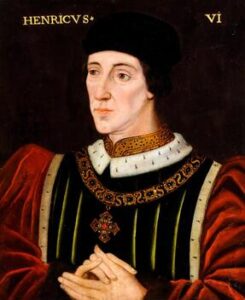
King Henry VI (c) National Trust
Henry VI (1421-1471) was the last Lancastrian monarch: a child king who struggled to exert authority as an adult. (The precedents set during his minority are important for understanding events at the accession of the next child king, Edward V). Disputes between Henry VI’s senior nobles led to armed conflict. Despite the best efforts of his queen, Margaret of Anjou, many of his subjects lost confidence in his kingship. Following a disastrous Lancastrian defeat at the Battle of Towton, Henry was ousted from the throne in 1461 by Edward IV. After four years in exile and on the run, Henry became a prisoner in the Tower of London. Internal squabbles among the Yorkists led to his brief ‘readeption’ in 1470 but the following year Edward IV regained the throne and Henry’s only child, Edward of Lancaster, was killed in battle. Henry’s death was widely assumed to have been murder.
Historians continue to debate the reasons for his failure as king. Was his upbringing by kinsmen in perpetual conflict so traumatic that he failed to learn the skills of kingship? Did he fail to mature mentally into adulthood? Was he unfortunate in that his well-meaning disposition could not cope with an age of exceptionally ambitious noblemen? Was he too saintly for kingship or too wilful and capricious? Or had his father bequeathed him an impossible situation with an unwinnable war in France that was compounded by marriage to a queen who antagonised sections of his nobility?
Henry was born 6 December 1421, the son of King Henry V and Catherine of Valois. Their marriage was a result of the Treaty of Troyes whereby Henry V became heir to Catherine’s father, King Charles VI of France. Henry V died on 31st August 1422 and Charles VI on 21st October of the same year, leaving Henry VI king of both kingdoms while not yet a year old. His eldest uncle, John duke of Bedford, was appointed regent of English France (most of today’s northern and south-western France). His younger uncle, Humphrey duke of Gloucester, believed that he should be regent in England. Other nobles, chiefly Henry VI’s Beaufort great uncles, determined that instead England should be ruled by a council of which Gloucester should be the chief member as ‘Protector and Defender of the Realm’.
On 5 November 1429 Henry, aged seven, was crowned king of England at Westminster Abbey and when travelling to France was considered to be safe, he was crowned king of France in Paris on 16 December 143, aged ten. Gloucester ceased to be Protector once Henry VI was crowned, although he remained chief councillor except when his brother, the duke of Bedford, was in England. On 19 May 1436 Henry’s tutor and governor, Richard Beauchamp, earl of Warwick resigned and no successor was appointed so that Henry seems to have drifted towards his majority from age 13, but still dependent on his councillors. By the early 1440’s Bedford was dead, Beaufort and Gloucester had lost much of their authority and his closest companion was the steward of his household, William de la Pole, earl of Suffolk, In 1444 Suffolk negotiated a truce with France involving Henry’s marriage to the French queen’s niece, Margaret of Anjou. They were married on 22 April 1445.
Despite the marriage, and the very unpopular decision to surrender control of Maine, hostilities between England and France resumed in July 1449. Meanwhile royal finances were in a parlous state. Henry nonetheless spent lavishly on his religious and educational foundations: Eton College, and King’s College, Cambridge. Suffolk was increasingly blamed both for the financial disaster and for the failure of policy in France as Charles VII regained Normandy. Suffolk was impeached in February 1450. King Henry tried to protect him, refusing to make a decision on the charges against Suffolk. Suffolk was eventually banished for five years but was captured at sea and executed. It was the fallout from this which led to Jack Cade’s popular rebellion of 1450.
Edmund Beaufort, duke of Somerset, who had been forced out of Normandy, now became Henry’s closest councillor. Henry repeatedly rejected Richard duke of York’s attempts to oust Somerset. In 1453 Henry ennobled his Tudor half brothers, Edmund and Jasper, and gave them the wardship of Margaret Beaufort, whom Edmund promptly married. He appeared to have recovered politically from the disasters of 1450 and his queen, Margaret of Anjou, was finally pregnant. But in July 1453 news arrived of a catastrophic defeat at Castillon in Gascony. Shortly afterwards Henry collapsed mentally and physically, unable to speak or feed himself, let alone respond to the birth of his son, Edward of Lancaster. After months of crisis, the duke of York became Protector of the Realm on 25 March 1454.
After Henry’s recovery the following Christmas, York was relieved of office and by the spring of 1455 the Lancastrian status quo had resumed. York and his closest allies, the earls of Salisbury and Warwick, were excluded from a Great Council summoned in April that year. This proved the trigger for the first battle of the Wars of the Roses, at St Albans on 22 May 1455. Henry did not participate in the fighting but was wounded in the neck. Somerset was killed and York essentially took control of the government. He briefly became Protector again, but was unable to command sufficient support among the nobility.
Following the collapse of York’s second protectorate, Henry and his queen were frequently in the Midlands at Coventry functioning almost as a second capital. After military conflict broke out again in 1459, a parliament held here attainted the duke of York and his allies. The Lancastrian triumph proved short-lived. York’s son, Edward, earl of March, together with the earls of Salisbury and Warwick, defeated Henry’s forces at Northampton and took him prisoner as their puppet king. On 31 October 1460 King Henry accepted the Act of Accord which disinherited his own son in favour of the duke of York.
After York’s death at the Battle of Wakefield, Margaret of Anjou and her son accompanied forces still loyal to Henry towards London. The earl of Warwick took Henry with him when he went to face this army, perhaps hoping men would be unwilling to attack their king. It was a significant miscalculation as Warwick was defeated at the second battle of St Albans and Henry was reunited with his queen and their son. However, the citizens of London refused them entry. Meanwhile Edward, now 4th duke of York, had won a battle at Mortimer’s Cross and the royal army heading north. Edward proceeded to London and was acclaimed king. Henry and Margaret were in York when their army was defeated at Towton by the new king Edward IV.
Mary of Gueldres, queen regent of Scotland, initially offered support to Henry and his family. Henry remained in Scotland, occasionally joining raids into northern England, while Queen Margaret sought help in France. Henry was eventually forced into northern England by an Anglo-Scottish truce and was captured in July 1465. At his brief restoration (readeption) in 1470-71 Henry again seems to have been no more than a puppet of the earl of Warwick and his allies. Warwick was killed in the rout after the Battle of Barnet in April 1471. At the Battle of Tewkesbury in May 1471 Henry’s son was killed and his queen was brought back to the capital in Edward IV’s custody. Henry died within hours of Edward IV’s arrival.
The widespread assumption that Henry VI had been murdered despite his sacred status as a king inspired some to venerate him as a saint. Many miracles were allegedly witnessed at his tomb at Chertsey. In 1484 Richard III moved his body to St George’s Chapel, Windsor, where Edward IV had been buried.
__________________________________
“The traditional view that Henry was the epitome of Christian virtue is myopic. At the other extreme, K. B. McFarlane’s view that he never acquired the mental equipment of an adult is contradicted by evidence. Nor is it easy to endorse B. P. Wolffe’s verdict of a wilful and untrustworthy incompetent. Rather does he seem well intentioned with laudable qualities, especially in relation to war, education, and religion, but with other qualities that were obstacles to effective kingship—extravagance, generosity, compassion, and suspicion. He disappointed many of his subjects by failing to provide fair and effective justice. He lacked foresight and discrimination; instead, simplicity was the abiding characteristic that contemporaries ascribed to him. He was neither uneducated nor unintelligent, but he remained inexpert in government and politics, and found it difficult to assert his independence and to concentrate on kingly matters in which he had little interest.”
Ralph Griffiths, Oxford Dictionary of National Biography
____________________________________
Henry VI’s book of psalms can be viewed online here.
A stunningly 15th century illustrated ‘Life’ of Henry’s tutor, Richard Beauchamp, Earl of Warwick – the Beauchamp Pageant – can be viewed here. It includes images of Henry’s life too if you click at least ten pages into the book.
JLL